

The short answer
You can take rough chest, waist, shoulder, sleeve and jacket length measurements at home with a flexible tape measure, a mirror, and ideally a second person to help, useful preparation before a tailoring consultation, especially for remote or first-time enquiries. These self-measurements are a starting point, not a substitute for a professional fitting — posture, asymmetry and drape can only be properly assessed in person. Clients preparing to visit Manchester Tailor BKK in Bangkok, or booking a remote consultation from abroad, often send rough measurements ahead simply to speed up the first conversation.
Why Self-Measurement Is Useful, With Limits
Taking your own measurements before a consultation isn't about replacing professional fitting — it's about arriving prepared and giving a tailor a useful starting reference, particularly if you're booking a remote consultation or simply want to understand your own proportions better. A tape measure at home can capture straightforward numbers like chest circumference reasonably accurately; it cannot capture posture, muscle asymmetry, or how cloth will actually drape on your frame, which is why an in-person fitting remains essential for anything bespoke.
How to Take Your Own Measurements Before a Tailoring Consultation
Use a flexible fabric tape measure rather than a rigid ruler, and take measurements over a well-fitting shirt rather than bare skin or bulky clothing, since either extreme will distort the numbers. Stand naturally rather than pulling your shoulders back or sucking in your stomach — tailoring measurements should reflect how you actually stand day to day, not a posed position.
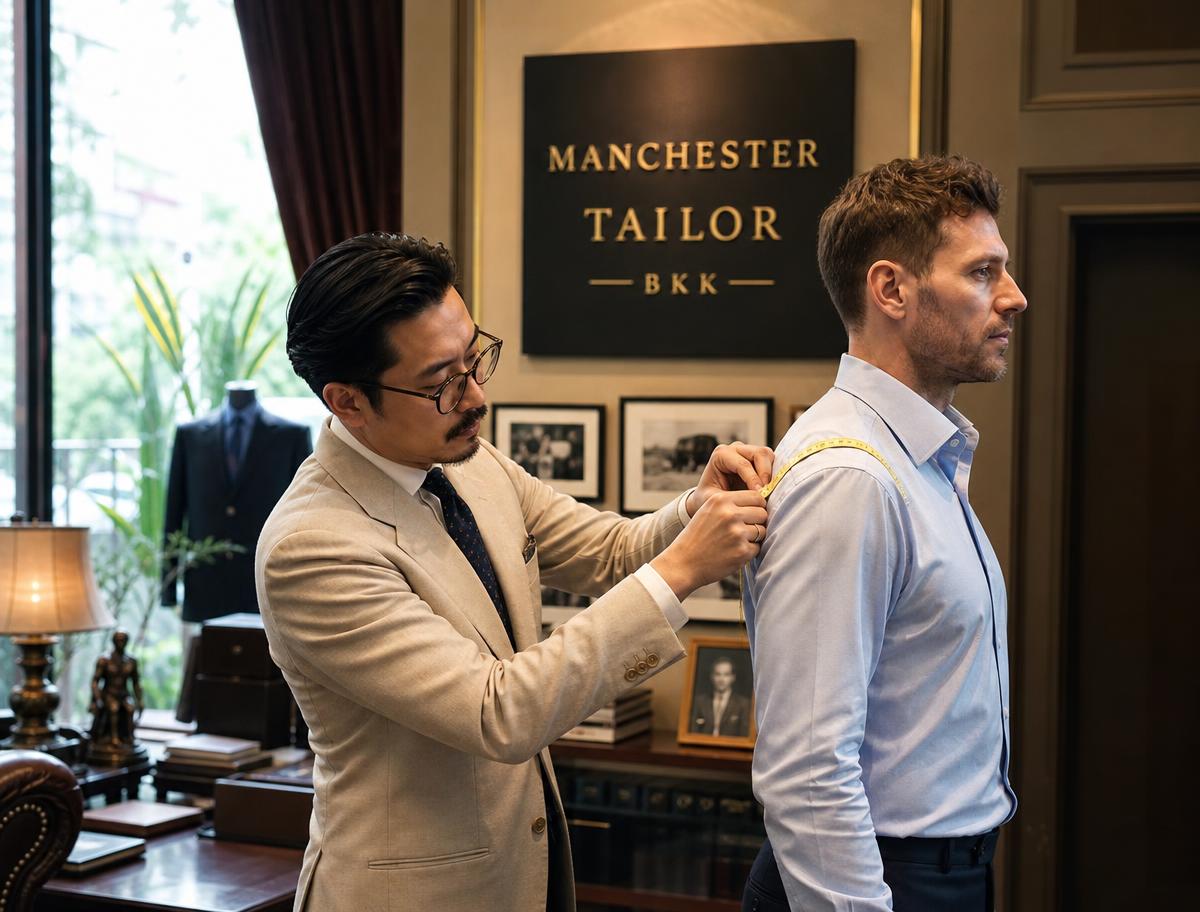
For chest, wrap the tape around the fullest part of your chest and upper back, keeping it level and snug but not tight — you should be able to slide two fingers underneath comfortably. For waist, measure around your natural waistline, typically at or just above the navel, again without pulling the stomach in. For shoulder width, measure straight across the back from the tip of one shoulder bone to the other, ideally with a second person holding the tape flat, since this measurement is difficult to take accurately alone.
For sleeve length, start at the shoulder tip and run the tape down the outside of a slightly bent arm to the wrist bone. For jacket length, if measuring an existing well-fitting jacket rather than your body, measure from the base of the collar straight down the back to the hem.
Common Self-Measurement Mistakes
- Pulling the tape too tight, which produces a measurement smaller than your actual size.
- Measuring over thick clothing, adding false bulk to chest and waist figures.
- Standing unnaturally straight or pulled-in, distorting waist and chest numbers.
- Measuring shoulder width alone without help, which is nearly impossible to do accurately by yourself.
- Rounding numbers rather than recording them precisely to the nearest centimetre.
What Self-Measurement Cannot Replace
Even a perfectly taken set of self-measurements can't account for posture — whether you carry your shoulders slightly forward or back, whether one shoulder sits marginally lower than the other, or how your body actually moves in daily life. These are exactly the details a tailor assesses visually and physically during an in-person consultation, and they matter more to final fit than the raw numbers themselves.
This is why self-measurements are best treated as a head start for a conversation, not a finished specification. A tailor will still want to take their own measurements before cutting a pattern, cross-referencing against what you've provided to flag any inconsistencies.
Using Self-Measurements for a Remote Consultation
For clients based outside Bangkok, or planning a trip and wanting to start the process before arriving, sending rough self-measurements ahead of a video consultation can help a tailor prepare fabric and style recommendations in advance, saving time once you're in the showroom or being visited for an in-hotel fitting. It's still standard practice to take full, professional measurements at the first in-person meeting, since that's the version the actual pattern will be cut from.
Frequently asked questions
- Should I send self-measurements before visiting Manchester Tailor BKK?
- It's helpful for remote consultations or to speed up a first conversation, but a full in-person measurement session will still be done before any pattern is cut.
- What's the hardest measurement to take on your own?
- Shoulder width — it requires a straight, level line across the back that's very difficult to hold accurately without a second person's help.
- Do I need special equipment to measure myself at home?
- Just a flexible fabric tape measure and, ideally, another person to help with back and shoulder measurements.