



The short answer
The most common suit fit mistakes are shoulders that extend past the natural bone, jacket sleeves left too long, trousers that pool excessively at the shoe, and buying a size based on chest measurement alone while ignoring shoulder width. These errors persist even among stylish men because they're subtle in a mirror but obvious in photographs and side profile. In Bangkok, where humidity also punishes oversized, heavy fabric choices, these mistakes are compounded by cloth that's simply too warm for the climate.
Why Fit Mistakes Survive Even Careful Dressers
It's tempting to assume that men who invest time in their wardrobe have fit fully sorted, but fit mistakes are often invisible from the angle you check yourself in — a front-facing mirror. Shoulder overhang, back collar gaps and trouser break issues show up from the side or in candid photos, angles most people rarely study themselves from.
There's also a psychological factor: many men default to sizing up 'to be safe,' assuming a slightly larger suit reads as more comfortable or more generous, when in tailoring terms it almost always reads as sloppy rather than relaxed.
Common Suit Fit Mistakes Even Well-Dressed Men Make
- Buying by chest size alone and ignoring shoulder width, since a jacket can only be taken in at the waist, not narrowed at the shoulder.
- Sleeves left long enough to fully cover the shirt cuff, hiding the 1–1.5cm of cuff that should be visible and making the arm look shorter.
- Trousers with too much break, creating fabric folds that break the vertical line of the leg — particularly unflattering in lightweight tropical cloth.
- Jackets bought a size up 'to be safe,' which oversizes the shoulder and chest simultaneously and cannot be corrected without a rebuild.
- Ignoring the back collar gap, often the clearest visible sign that a jacket's balance is off.
- Wearing a belt with trousers cut for braces, or vice versa, disrupting the intended waist line.
The Shoulder Overhang Problem
Shoulder overhang — where the jacket's shoulder seam sits visibly past the bone — is arguably the most common and most damaging mistake, because it cannot be fixed by any standard alterations tailor. Once a jacket is cut with too wide a shoulder, correcting it requires deconstructing and rebuilding the sleeve head and shoulder line, work that few alterations shops are equipped or willing to do.
This is precisely why the shoulder should be the first checkpoint when trying on any jacket, tailored or off-the-rack, and why bespoke tailoring — where the shoulder is cut to your exact bone structure from the outset — avoids the problem entirely rather than trying to fix it after the fact.
Sleeve Length and the Missing Cuff
Sleeves that run too long are extremely common because many buyers instinctively want more coverage, associating longer sleeves with formality. In fact, a jacket sleeve that fully covers the shirt cuff makes the arm look shortened and the overall silhouette less deliberate. The correct length leaves 1 to 1.5 centimetres of shirt cuff showing at the wrist — a small detail that reads immediately as considered tailoring rather than an off-the-rack purchase.
Trouser Break in a Tropical Climate
Excess trouser break — where fabric stacks and folds above the shoe — was once a default in cooler markets with heavier cloth, but it reads especially poorly in Bangkok, where lighter tropical-weight wool and linen blends show creasing and stacking more visibly than heavier flannels do. A cleaner, shorter break with minimal stacking suits both the climate and the modern silhouette, and it's a simple adjustment a good tailor makes early in the fitting process.
How Bespoke Fittings Prevent These Errors
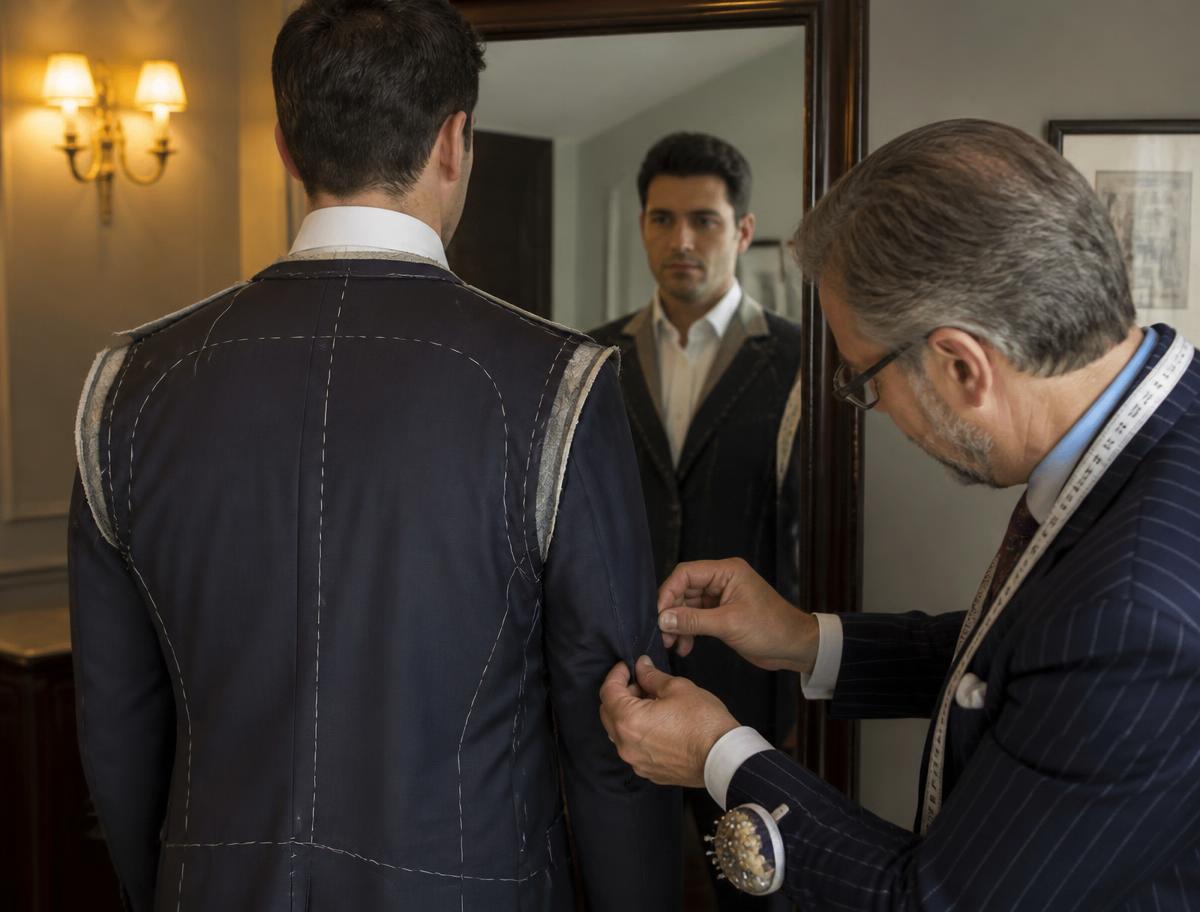
Most of these mistakes stem from buying a fixed size and hoping it works, rather than having a garment built to correct measurements from the outset. A staged bespoke process — individual pattern, baste fitting, forward fitting — catches shoulder overhang, sleeve length and trouser break before the garment is finished, rather than leaving the wearer to notice the problem months later in a photograph.
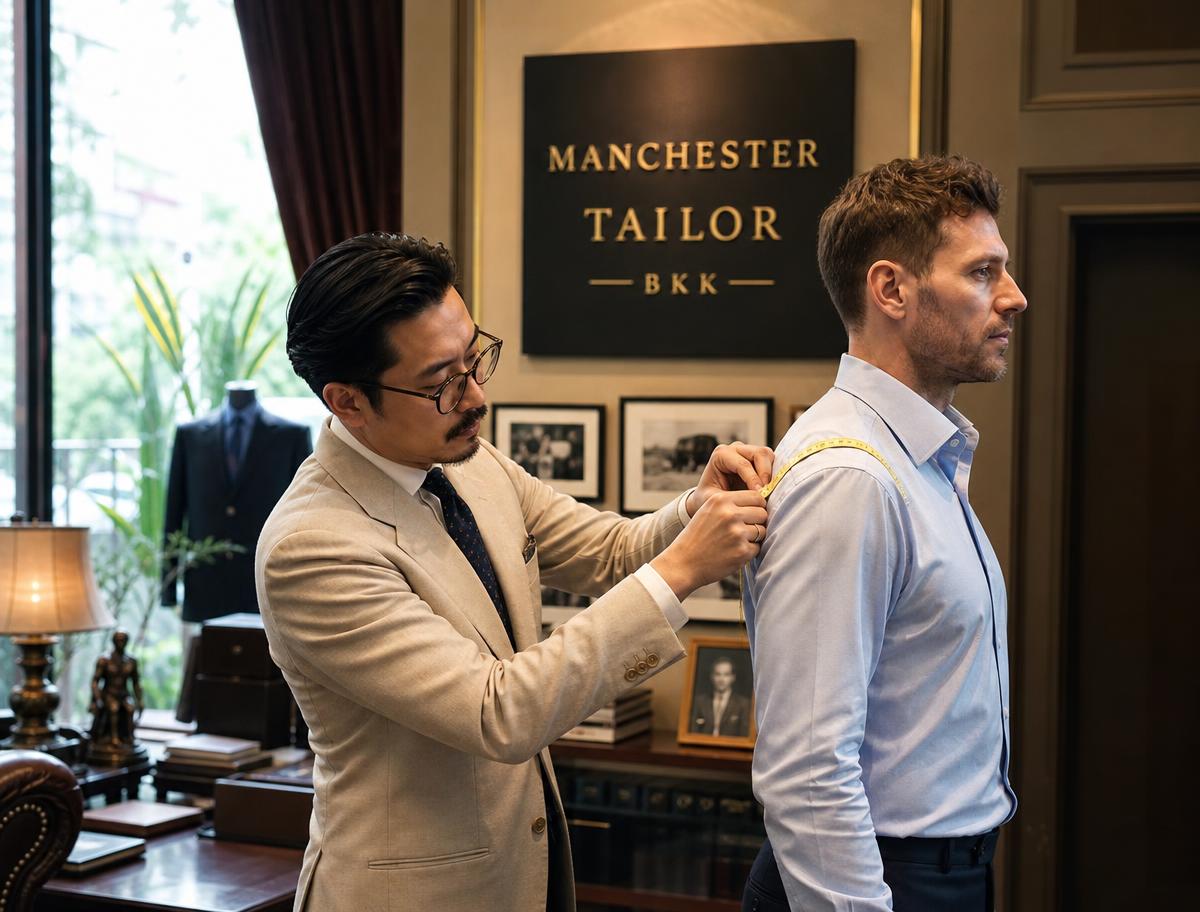
At Manchester Tailor BKK, these checkpoints are built into the standard fitting schedule rather than treated as optional extras, precisely because they're the errors that are hardest to correct after a suit has left the shop.
Frequently asked questions
- Can a tailor fix shoulder overhang after the jacket is made?
- Only with significant deconstruction and rebuilding of the shoulder and sleeve head, which most alterations tailors won't attempt; it's far better to get right at the pattern stage.
- Why do trousers with too much break look worse in Bangkok?
- Lightweight tropical wools and linens crease and fold more visibly than heavier cloth, so excess break shows up as untidy stacking rather than a subtle drape.
- Is it better to buy a suit slightly big or slightly small?
- Neither — but if forced to choose, slightly larger through the body is easier to take in than a suit too small to let out, since seam allowance is limited.