




The short answer
Women's bespoke suiting spans blazers, trousers and skirt suits, each with distinct pattern requirements — bust dart and sleeve pitch for the blazer, rise and leg line for trousers, and hip and hem allowance for a skirt — and none is inherently more formal or correct than the others in a modern business context. In Bangkok, cloth weight and construction choices matter as much as silhouette, since tropical heat affects trousers, skirts and blazers differently.
The Blazer: The Anchor of a Women's Suit
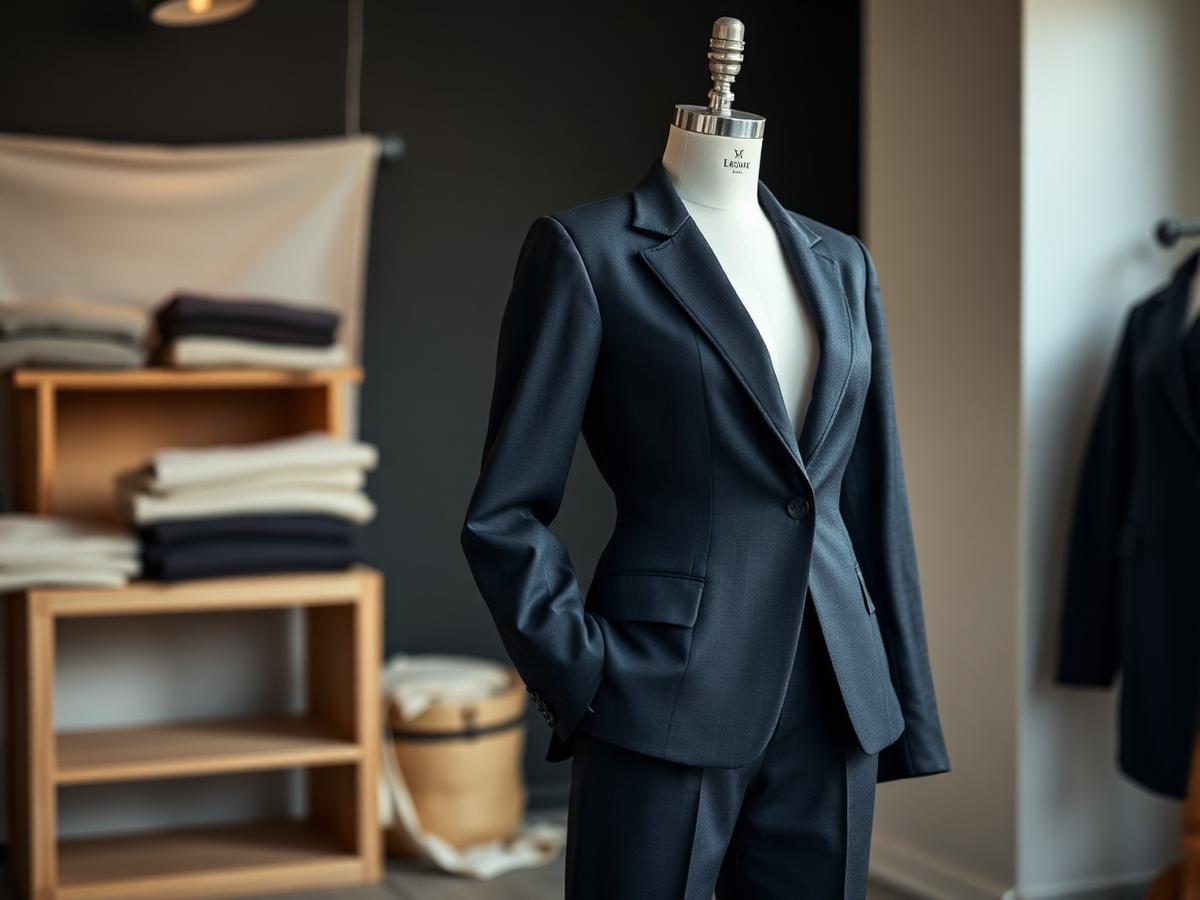
The blazer is generally the most complex piece to get right in a women's suit, since it has to account for bust dart placement, waist suppression and sleeve pitch simultaneously, and any error in one affects how the others read on the body. A well-cut blazer holds its line whether worn buttoned or open, sits flat across the shoulders without pulling, and follows the waist without gaping at the button point — all outcomes of an individually drafted pattern rather than an adjusted generic block.
Length is a further consideration specific to women's blazers: a shorter, cropped length suits a higher-waisted trouser or skirt and reads as more contemporary, while a longer length, closer to mid-hip, is more traditional and generally more forgiving across different trouser and skirt styles. Neither is more correct; the choice depends on the rest of the wardrobe it needs to work with.
Trousers: Rise, Suppression and Leg Line
Women's trousers require their own set of pattern decisions distinct from the blazer above them. Rise — where the waistband sits relative to the natural waist — significantly affects both comfort and silhouette; a higher rise elongates the leg line and pairs well with a shorter blazer, while a mid-rise is more versatile across different jacket lengths. Waist suppression in trousers works differently from a jacket, shaping the fabric to sit cleanly at the waist without a jacket to cover any looseness, which makes precise trouser fit more immediately visible than blazer fit in some settings.
Leg line — straight, tapered, or wide — is largely a style preference, but it should be chosen in coordination with the blazer length and the shoes it will most often be worn with, since a mismatch between trouser break and shoe style is one of the more common fit complaints in women's tailoring.
A Guide to Women's Bespoke Suiting: The Skirt Suit
A skirt suit introduces hip spring and hem allowance as its primary pattern considerations, alongside the waist suppression it shares with trousers. Hip spring — how much the fabric flares out from the waist over the hip — has to be calculated precisely enough to skim the body without clinging or pulling when walking or sitting, which is a different technical challenge from a trouser's leg line. Hem width and length also affect how much ease is built into the pattern for movement, particularly for a pencil skirt cut close to the body.
A skirt suit is neither more nor less formal than a trouser suit in most modern business contexts; the decision generally comes down to personal preference, workplace culture, and which silhouette the wearer finds most comfortable for a full working day, including time spent sitting, walking and standing in Bangkok's climate.
Choosing Between Trousers and a Skirt for the Same Blazer
One of the practical advantages of bespoke suiting is that a single blazer pattern can be paired with either a trouser or a skirt cut from the same cloth, giving a client two complete looks from one commission rather than committing to only one silhouette. This is worth discussing at the consultation stage, since ordering both from the outset, rather than adding the second piece later, allows fabric quantities and any pattern-matching across the pieces to be planned together from the start.
Fabric Considerations Across the Three Garments
Blazers generally benefit from a cloth with enough body to hold structure through the shoulder and chest — a mid-weight wool or wool-blend suits this well. Trousers can take a slightly softer drape, since they do not need to hold shape in the same way a jacket does, which opens up a wider range of wool and wool-blend options. Skirts, particularly close-fitting styles, often benefit from a small amount of stretch in the weave to accommodate movement, which is worth flagging specifically when selecting fabric for a skirt suit rather than assuming the blazer's cloth will automatically suit the skirt equally well.
For Bangkok's climate, tropical-weight wool in the 180 to 260 gram range performs well across all three garments, though skirts and trousers can occasionally go slightly lighter than a blazer if they are expected to be worn without the jacket on particularly hot days.
Building a Complete Bespoke Suiting Wardrobe
A considered order for a first full commission is one blazer, one trouser and one skirt cut from the same or coordinating cloth, giving three or four wearable combinations from a single fitting process rather than three separate, disconnected purchases. Because the individual patterns for each garment are retained after the first commission, future orders in different fabrics can be produced more efficiently, since the fit work has already been established.
Manchester Tailor BKK builds each of these three garment types — blazer, trouser and skirt — from its own individually drafted pattern, hand-cut and constructed through the same multi-fitting process used across its bespoke work, drawing on a fabric library of more than 5,000 cloths sourced directly from mills in Italy, England and Australia, from its Khaosan Area showroom in Bangkok.
Frequently asked questions
- Can one blazer be paired with both a trouser and a skirt?
- Yes — ordering a trouser and a skirt cut from the same cloth as a single blazer is a practical way to get more than one complete look from a single bespoke commission.
- Is a skirt suit less formal than a trouser suit?
- No — in most modern business contexts, neither is inherently more formal than the other; the choice comes down to personal preference and workplace culture.
- Do skirts need a different fabric from the blazer they are paired with?
- Not necessarily, though close-fitting skirts often benefit from a small amount of stretch in the weave, which is worth discussing separately from the blazer's fabric choice.
- How many fittings does a full blazer, trouser and skirt commission require?
- Each garment typically has its own interim fitting to check fit before finishing, so a full three-piece commission generally involves more total fitting time than a single blazer alone.